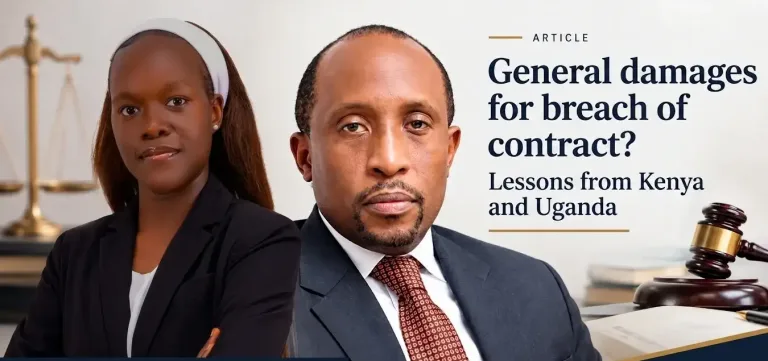

Who?
Mr Gilbert Nuwagaba of KGN Advocates. Advocate since 1997. Makerere University School of Law, Class of 1991-1994 and Law Development Centre (LDC), Class of 1994-95.
Why?
Mr Gilbert Nuwagaba defended the respondents in the recently decided Supreme Court case of Global Capital Save (2004) Ltd and Anor v Alice Okiror and Another.
This was a protracted legal dispute where a moneylender charged Alice Okiror and her late husband an illegal, harsh, and unconscionable interest of 144% per year on a loan.
The mortgage transaction based on that loan was found to be invalid for failing to meet the requirements of the law, that is, proper execution, attestation and prior written spousal consent.
His thoughts on the Case?
This is a very good case with various decisions on Motgages.
How mortgages should be executed especially where the parties opt to use a loan agreement as a mortgage deed at the same time.
The case brings out the superiority of the Registration of Titles Act (RTA) over the Companies Act regarding execution of documents for registration under the Registration of titles Act.
For instance under the companies Act, a director can sign any document for and on behalf of the Company but under the RTA, either the company executes with its Corporate seal or the Company appoints attorneys to sign on its behalf.
The case also emphasizes the importance of a spousal consent especially where the property constitutes Family land under the land Act. The transaction becomes null and void where no consent was obtained before any transaction such as mortgage or sale.
The Law requires that instruments under the RTA must be attested(witnessed).
It’s not enough for a Lawyer to just place his stamp and sign on the mortgage or transfer. He has to physically witness the execution of the document. In the Global capital case, Agaba Kakoni, an advocate purported to witness the mortgage but Alice Okiror denied ever signing any document in his presence.
Agaba did not testify to prove his presence and as such Court found that there was no due attestation.
From your experience litigating this matter and similar matters, where do you think money lenders fall short in preventing or responding to unconscionable transactions?
Money Lenders focus more on abnormal profits through inflated interest rates, illegally compounding of interest and failure to provide proper documentation.
In this case, Global capital had retained all documents including the mortgage and had refused to issue receipts for payments made.
By luck the accountant by some “lapse” gave our client a statement of account which formed the initial basis of our case.
Again by another stroke of Luck, when the late Okiror sought to pay a sum of 230M in cash and retrieve the certificate of title, Mr. Ben Kavuya had travelled out of town so upon being called on phone, he offered a bank account where it was deposited. Otherwise that too would not have been receipted and there would not have been any proof of payment .
The Court was able to determine from the statement that there was an overpayment as a result of charging unconscionable interest.
How would you explain to a non-lawyer the difference between a mortgage and a loan?
A Mortgage refers to the security(especially Land) given for a loan realisable in the event of failure to pay up the loan.
A loan on the other hand refers to the act of lending and borrowing.
A mortgage happens after the loan transaction has been concluded.
In the Global capital save case, the court found that the Loan agreement doubled as a mortgage and this was permissible under the repealed Mortgage Act.
How do you respond to Justice Monica Mugenyi’s dissenting opinion on the validity of the Mortgage in this case?
I think she agreed that the mortgage was invalid for the fact that it was not duly attested according to the law and for lack of spousal consent.
She only went ahead to find that the imperfections in attestation rendered it an equitable mortgage.
She also found that a director of a company under the companies Act can bind the company and as such the Mortgage was validly signed by Mr. Kavuya as Director.
This ofcourse would imply that provisions of the Companies Act override the RTA which concerns land matters which is absurd.
Hon Justice Tuhaise clearly clarified that where it concerns registrable Land under the RTA, provisions of the RTA reign supreme and quoted Section 2 of the RTA to that effect.
Why become a corporate and commercial lawyer?
This is mostly determined by your clientele.
I handle land matters mostly, but they tend to overlap into commercial matters.