

The comfortable myth
“Transfer pricing? That is for the telecoms, the banks and the oil companies. All my companies are right here in Kampala.”
I hear some version of this in almost every boardroom where a founder-led Ugandan group or fully Ugandan operations group reviews its tax position.
It is a comfortable belief. It is also wrong, and it will be expensive to hold.
Uganda’s transfer pricing rule does not ask where your companies are located.
It asks whether they are associates.
If the same family or shareholder controls the trading company, the property company and the transport company, every invoice that moves between them is a transaction between associates.
The Commissioner General can restate it to an arm’s length price.
As revenue targets climb and URA’s data analytics sharpen, wholly Ugandan groups are moving from the edge of the transfer pricing (TP) conversation to its centre.
This article explains why the law reaches you, which transactions draw attention first, and what a proportionate defence file looks like.
What the law actually says
The trigger for Uganda’s transfer pricing rule is the relationship between the parties, not the border between them.
The rule sits in Section 116 of the Income Tax Act, Cap 338, headed “Transactions between associates”.
Its operative words are deliberately wide.
In any transaction between associates, the Commissioner General may distribute, apportion or allocate income, deductions or credits between them, to reflect the chargeable income or tax that would have arisen had the transaction been conducted at arm’s length.
Read that sentence again and look for the words “foreign”, “non-resident” or “cross border”.
They are not there.
Who is an associate?
Section 3 casts the net in layers:
- The behavioural test. Where one person (other than an employee) acts in accordance with the directions, requests, suggestions or wishes of another, both are associates. No shareholding is needed.
- The 50% control tests. A company is an associate of any person who controls 50% or more of its voting power, alone or with associates, directly or through interposed entities. Two companies controlled at that level by the same person are associates of each other.
- Family and partners. Relatives and partners are associates unless the Commissioner General is satisfied that neither acts on the other’s wishes.
Now apply that to a typical family group.
The founder holds 60% of the trading company.
The spouse and children own the property company.
The trading company owns the transport company outright.
Under Section 3, every one of these persons and entities is an associate of every other, and every invoice between them is a controlled transaction.
The 2011 Regulations
The 2011 Regulations apply in full to purely domestic dealings, and since 1 July 2026 the arm’s length duty also sits on the face of the Act under section 115A.
Regulation 2 of the Income Tax (Transfer Pricing) Regulations, 2011 applies them to a controlled transaction where one party is located in and subject to tax in Uganda, and the other party is located in or outside Uganda.
A controlled transaction is simply a transaction between associates (Regulation 3).
So the full toolkit applies to your domestic group:
- The arm’s length obligation and the methods: Comparable uncontrolled price, resale price, cost plus, transactional net margin and profit split, with the most appropriate method chosen (Regulation 7).
- Comparability: Characteristics of the goods or services, functions, assets and risks, contractual terms, economic circumstances and business strategies (Regulation 4).
- Documentation: Records sufficient to verify arm’s length pricing, in place before the return due date (Regulation 8).
- The OECD Guidelines. The Regulations are applied consistently with the OECD Transfer Pricing Guidelines, with the Act prevailing in any conflict (Regulation 6).
Section 115A: from regulation to statute
The Income Tax (Amendment) Act, 2026, assented to on 20 August 2026 with effect from 1 July 2026, inserts a new Section 115A.
A person who enters into a controlled transaction, or a series of them, must account for it consistently with the arm’s length principle.
This is more than tidying up.
Before, the duty lived mainly in subsidiary legislation and URA had to build the case for an adjustment.
Now, it is a statutory obligation on the taxpayer, and the practical burden shifts: you are expected to show from the outset that your related party pricing is commercially justifiable.
The UGX 500 million documentation trigger
URA’s 2012 Practice Note on Transfer Pricing Documentation requires a documentation file where domestic controlled transactions reach UGX 500 million (25,000 currency points) in aggregate in a year of income.
Cross-border controlled transactions have no threshold.
Two cautions:
- It is a documentation trigger, not a safe harbour. Sections 115A and 116 apply to every transaction between associates, whatever its size.
- It arrives quickly. UGX 30 million a month in related-party rent plus UGX 15 million a month in management fees is UGX 540 million a year. Most mid-sized groups are already over the line.
Why URA cares when all the tax stays in Uganda
URA cares because Uganda taxes each company on its own, so moving profit between group members changes the group’s total tax bill.
The usual objection runs:
“Both companies pay tax in Uganda, so URA gets its money either way.”
That holds only if both pay the same effective rate, in the same year, on the same base.
They rarely do.
Uganda has no group taxation regime.
There is no consolidation and no surrender of losses between group companies.
That is precisely why the profile of each group member matters:
One more point is often missed.
Section 116 does not require a tax differential at all.
Even where every entity pays 30%, URA can adjust a non-arm’s-length price.
The differentials simply tell you where URA will look first.
The transactions URA looks at first
In a domestic group audit, URA usually starts with seven flows, and the red flags are remarkably consistent.
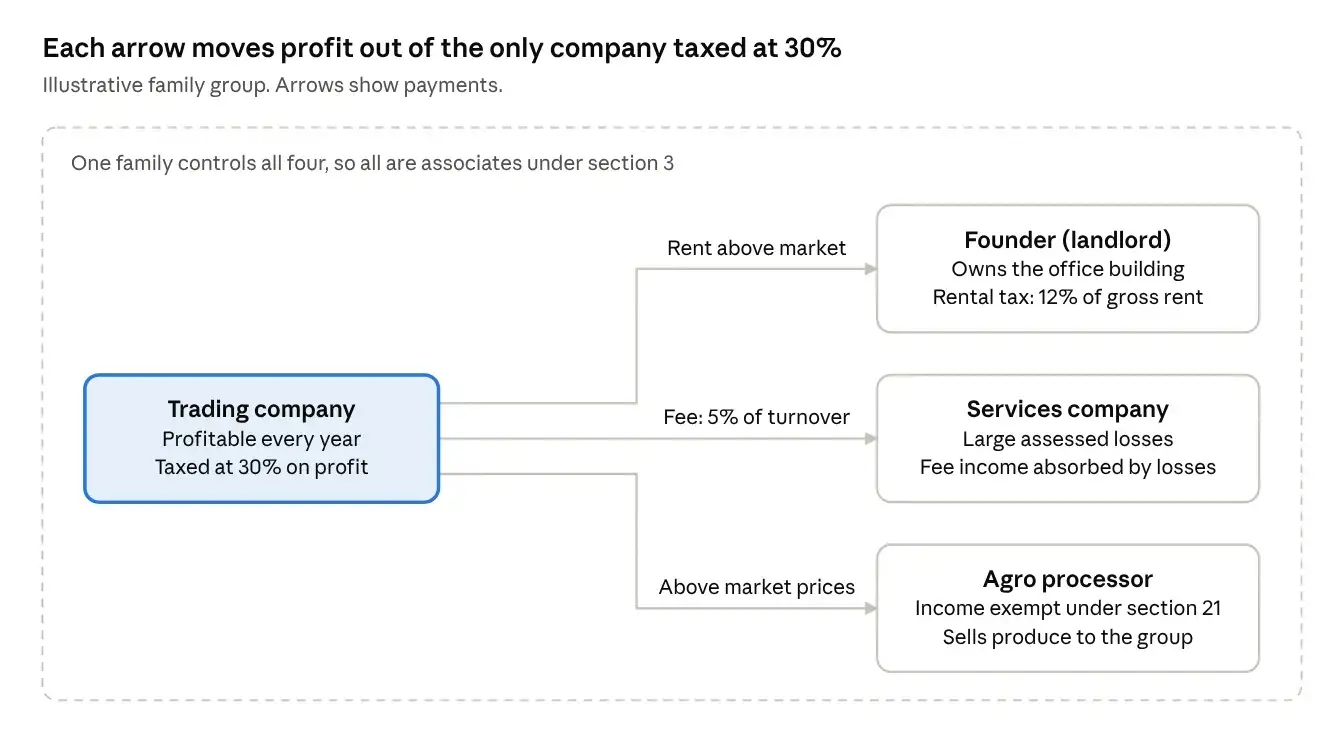
Only the trading company pays 30% on its profit. Every arrow moves profit to a recipient where it bears less tax, which is exactly where URA starts.
| Transaction | Typical red flag | URA’s likely challenge |
| Management and shared service fees | A flat percentage of turnover, no agreement, no evidence of what was delivered | Were the services rendered, did the payer benefit, and is the charge more than cost plus a modest markup? |
| Rent for group or owner property | No lease, or rent that rises when the tenant becomes profitable | Is the rent above market for comparable space? |
| Intra-group loans and advances | Interest-free advances to a loss-making sister, or rich interest charged by a holding company | Is the rate commercial, is it really debt, and does the 30% EBITDA cap bite? |
| Sale of goods between trading arms | An exempt or loss-making entity sells to its profitable sister at inflated prices, or buys below cost | How do these prices compare with sales to unrelated customers? |
| Shared staff, vehicles and premises | All costs sit in one company while several benefit | Where are the allocation keys, and are they applied consistently? |
| Asset transfers and restructurings | Land, vehicles, brands or customer contracts moved at book value or for nothing | What was the market value? Section 51(2) already brings disposals to an associate in at market value |
| Owner arrangements | Personal expenses and undocumented shareholder loans in the company books | Is this a deductible business cost, a genuine loan, or disguised income? |
The rules that travel with transfer pricing
Section 116 rarely arrives alone; in a domestic audit, expect URA to run five companion provisions alongside it.
- Income splitting: Where a taxpayer attempts to split income with an associate, for example by transferring income or income-producing property to a relative or a related entity, the Commissioner General may adjust the chargeable income of both to prevent the tax saving. It is aimed squarely at family structures.
- Recharacterisation: URA may recharacterise a transaction entered into as part of a tax avoidance scheme, disregard one that lacks substantial economic effect, or recharacterise one whose form does not reflect its substance.
- Interest capping: Interest deductions of a group member are capped at 30% of tax EBITDA, with the excess carried forward for up to three years. From 1 July 2026, a group means persons other than individuals with at least 51% common underlying ownership, excluding dormant members. A wholly Ugandan group sits squarely inside this rule.
- VAT on associate supplies: Under the VAT Act, a supply between associates for no consideration, or for less than fair market value, is valued at fair market value. A waived management fee or a discounted rent can create output VAT exposure even where income tax is neutral.
- Withholding tax: Intra-group fees and interest can carry withholding obligations. In URA v ATC Uganda Limited (Court of Appeal, 27 March 2026), a cross-border case, the Court held that capitalising accrued interest on a shareholder loan was a “payment” that triggered withholding tax. Where withholding applies to domestic interest, accruing it rather than paying cash does not avoid the obligation.
What getting it wrong costs
A single undocumented management fee can cost a mid-sized group close to UGX 370 million for one year of income, before anyone argues about penalties for understatement.
How URA finds it
Domestic TP issues rarely need a tip-off.
The data is already in URA’s hands:
- the IAS 24 related party note in the audited financial statements filed with the return;
- electronic invoicing data from EFRIS showing invoices between group TINs;
- intercompany balances that do not agree between the two entities’ books;
- withholding tax and VAT returns that do not match the ledgers;
- the returns of related entities, read side by side.
A worked illustration
OpCo, a profitable trading company, pays ServiceCo, a group company with large brought forward losses, a management fee of UGX 1.2 billion a year.
The fee is set at 5% of turnover, with no agreement and no record of what was delivered.
On audit, URA accepts only ServiceCo’s documented cost of serving OpCo plus a modest markup, UGX 480 million.
| Item for one year of income | UGX million |
| Fee disallowed for OpCo | 720.0 |
| Additional tax at 30% | 216.0 |
| Interest at 2% a month, simple, for 24 months | 103.7 |
| Penal tax if TP records are not produced within 30 days of request | 50.0 |
| Exposure for one year | 369.7 |
The hidden cost: tax on the same shilling twice
ServiceCo has already reported the full UGX 1.2 billion as income and used its losses against it.
Nothing in Section 116 or the Regulations obliges URA to make a matching downward adjustment for ServiceCo.
The corresponding adjustment mechanism in Regulation 10 covers only adjustments made by a treaty partner.
In a purely domestic case, relief for the counterparty has to be argued for at objection.
Without a file, you argue from a weak position.
The wider exposure
- Interest on unpaid tax runs at 2% a month, capped at the aggregate of the principal tax and penal tax.
- Penal tax of UGX 50 million applies for failing to furnish TP records within 30 days of a request, under section 49A inserted into the Tax Procedures Code Act.
- Criminal sanction under regulations 7(6) and 8(4): a fine of up to 25 currency points (UGX 500,000), imprisonment of up to six months, or both. The fine is small; the reputational cost is not.
- Time. URA can generally amend an assessment within three years, and without limit for fraud or gross neglect.
- Burden of proof. Before the Tax Appeals Tribunal, the taxpayer must prove the assessment wrong. Since Section 115A, that burden is practically front-loaded.
A proportionate documentation strategy
Domestic groups do not need a multinational’s master file; they need a file that answers three questions.
What was the transaction, why was it priced that way, and can you prove it happened?
Layer 1: hygiene for every group, whatever its size
- A related party register covering every associate under Section 3, reconciled to the IAS 24 note.
- Signed intercompany agreements for each recurring flow: services, rent, loans and supply of goods.
- Board approval of pricing policies, loans and asset transfers.
- Evidence of delivery: reports, timesheets, minutes and correspondence.
- Cost pools and allocation keys, written down and applied consistently.
- Invoices actually raised and settled, with withholding tax and VAT dealt with.
Layer 2: a local file once domestic controlled transactions reach UGX 500 million
Build it around the six heads of URA’s 2012 Practice Note: company details, industry overview, the controlled transactions, functional analysis, financial analysis and economic analysis.
It must be in place before the return due date, six months after year-end, and be ready to hand over within 30 days of a request.
Layer 3: pricing anchors that hold up
| Flow | Practical arm’s length anchor | Evidence to keep |
| Routine support services (accounts, HR, IT) | Cost plus a modest markup; the OECD simplified approach for low value-adding services (5% on cost) is a defensible reference under regulation 6 | Cost pool, allocation keys, service descriptions |
| Rent | Market rent for comparable space | Independent valuer’s opinion, registered lease, rent review clause |
| Loans | Commercial bank lending rates for similar tenor, currency and security | Loan agreement, rate rationale, repayment record |
| Goods | Internal comparables: prices charged to unrelated customers | Price lists and third-party invoices |
| Distribution | Gross margins earned by independent distributors | Resale price analysis |
| Strategic or high-value services | Benchmarked net margin (TNMM) | Functional analysis and benchmarking study |
Two practical notes:
- Local data is thin. Ugandan company financials are scarce, so benchmarks usually rely on regional or pan-African sets. Record why each comparable is comparable.
- Consider certainty for big recurring flows. Where an exempt processor supplies a taxable group company, for example, an advance pricing agreement [APA] under Regulation 9 is available. APAs are rarely concluded in practice, but preparing the application imposes useful discipline.
The bottom line
If you own more than one company, or your company deals with you, your family or your other businesses, you are in transfer pricing territory today.
Section 116 has always said so.
Section 115A now says it louder, and URA has the data to act on it.
The groups that come through the next audit cycle well will be those that treat their own companies as strangers: written terms, market prices and proof of delivery.
Price your related parties as if they were independent, and keep the evidence that you did.

Alfred Habaasa, CPA
Alfred Habaasa is a dual-qualified Tax Lawyer and a Certified Public Accountant (CPA). He currently leads the Tax Practice at REDMOND TAX & ADVISORY and is a Co-Founder of TaxIQ Africa, a pan-African transfer pricing specialist firm. With a career spanning over a decade of specialised practice in public and private sectors, Alfred is a recognised expert in international taxation, transfer pricing, and the taxation of extractives (Oil, Gas, and Mining).
Prior to his current roles, Alfred served as a Team Leader at the Uganda Revenue Authority (URA) from 2019 to 2025, where he directed complex Transfer Pricing audit teams reviewing major International Oil Companies (IOCs) and contractors within Uganda's energy sector. His private sector tenure includes previously serving as a Senior Tax Advisor at Ernst & Young (EY) Uganda between 2015 and 2019, where he successfully defended multinational clients against sophisticated tax authority challenges and designed robust corporate tax strategies.
A passionate educator and thought leader, he regularly trains professionals across the African continent in Transfer Pricing and international tax and has contributed widely to international academic literature, including the IBFD International VAT Monitor. He is also a distinguished speaker and has spoken at high-level tax forums.